Roof Work
Commercial Solar Roof Integration.
Charleston, SC solar-ready commercial roofing: we handle the racking penetrations, membrane compatibility, weight and uplift checks, and the warranty coordination.
Request Roof WalkCommercial Solar
Roof Integration
Commercial Solar Roof Integration Roof Planning
- Roof walk notes tied to the building's access, drainage, and operating limits.
- Photos and observations that separate urgent protection from longer-term scope planning.
- Clear next steps for repair, maintenance, coating, recover, replacement, or further testing.
Roof Scope Notes
Every commercial array in the Lowcountry is mounted to a roof, and yet The Roof Is the part of the project that gets the least attention until something goes wrong. We are roofers, not a solar contractor, and our job on these jobs is narrow and important: make sure the membrane an owner is about to cover for the next two decades can actually take the array, and make sure the work the solar crew does on top does not quietly destroy the roof warranty underneath. We have walked these projects on warehouse roofs along Palmetto Commerce Parkway, on retail and office buildings in Mount Pleasant across the Ravenel Bridge, and on institutional buildings downtown near MUSC, and the gap is always the same. The energy model is detailed; the roof it sits on is an afterthought.
Before anyone talks panels, we want a defensible number for the remaining service life of the membrane. The reason is purely financial. Setting an array, then having to disconnect, remove, store, and reinstall it a few years later to do a tear-off is one of the most wasteful sequences in commercial roofing, and it can run into the tens of thousands on a mid-size roof without producing one additional watt. If we core a roof and find it has well over a decade of honest life left, solar on the existing surface is reasonable. If it is near the end, the right and cheaper move is to re-roof first and let the racking land on a fresh, fully warranted membrane. We hand the owner that life estimate up front so the decision rests on the roof's real condition rather than optimism.
Ballasted racking keeps the array in place with weighted trays and pavers and never pierces the membrane, which sounds ideal until you weigh it. The ballast, the rails, and the modules all pile Dead Load onto a deck framed years ago for far less. We check that added pounds-per-square-foot against the structure's real capacity, and we insist on slip sheets or protection layers under every ballast pad that the membrane manufacturer approves. Ballast dragged straight across a TPO or PVC sheet grinds it from below, in the one place nobody thinks to inspect.
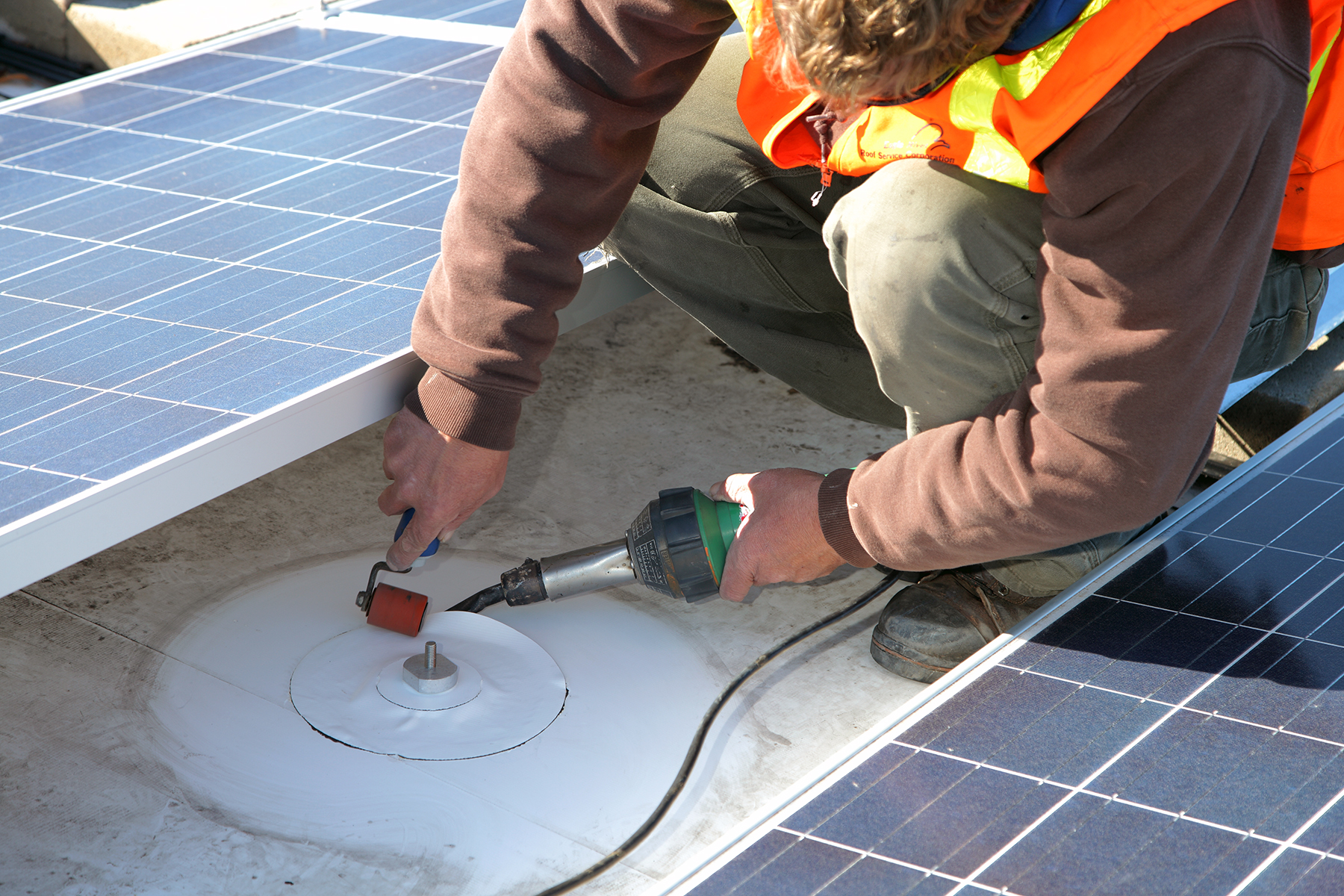
Mechanically attached racking anchors stanchions through the membrane into the deck or structure, and every one of those feet is a hole through your roof. We treat each one as exactly what it is, a penetration that has to be flashed to the manufacturer's published detail with proper base flashing and target patches, and rolled into the membrane warranty. We also confirm the racking metal and every sealant the solar crew plans to use are chemically compatible with the sheet, because an incompatible sealant against single-ply is a slow failure we end up cutting out later.
Charleston sits in a high-wind coastal zone, and the building code here puts real numbers on uplift for good reason. An array is aerodynamically a field of small wings. A ballasted system sized for a calmer design wind speed than the coast actually delivers can be scoured or shifted in a storm; an attached system funnels uplift straight into the deck through the racking fasteners. We coordinate so the racking attachment pattern and the membrane attachment pattern work together rather than against each other, and so the perimeter and corner zones, where uplift pressure spikes hardest, get the extra securement the wind map calls for. After a named storm pushes through the harbor, a marginal array on a marginal roof is the first call we get.
Power has to travel from the array down into the building's service, and that wiring crosses the membrane at several points. The most common failure we find is conduit clipped flat to the sheet, or run before the roofer was ever brought in. Conduit fastened directly to the membrane saws into it through every thermal cycle, and a generic boot that was never meant for a through-roof conduit weeps within a season. We map conduit routing with the solar EPC during pre-construction, set the runs on standoffs so they float clear of the membrane, and flash every crossing with a detail built for it rather than something improvised on the day of.
This is the seam that quietly costs owners the most. A single-ply manufacturer will only stand behind its warranty over an array if that array followed the manufacturer's rules: approved ballast pads, approved walk pads for service access, approved penetration details, and in most cases a pre-installation review by the manufacturer's field representative. If the solar crew penetrates a warranted roof with none of that, the membrane warranty can evaporate, and the owner ends up with panels under warranty and a roof that nobody covers. We stand between the two trades and keep both intact: we schedule the manufacturer's review before any racking is set, document the penetration and protection details for the warranty file, and confirm the final inspection clears both the roofing registration and the solar commissioning.
Questions Building Owners Ask
Related Roof Planning
Auto Dealership Roofing
Commercial roofing for auto dealerships, car lots, service centers, and automotive facilities throughout Charleston, SC.
Government and Municipal Building Roofing
Commercial roofing for city halls, courthouses, fire stations, police stations, and public facilities throughout Charleston, SC.
PVC Commercial Roofing
PVC Commercial Roofing for Charleston commercial buildings. Roof inspection, documentation, repair, maintenance, and replacement planning.
Roof Recover and Overlay
Roof Recover and Overlay for Charleston commercial buildings. Roof inspection, documentation, repair, maintenance, and replacement planning.
Edge Metal, Coping, and Gutters
Edge Metal, Coping, and Gutters for Charleston commercial buildings. Roof inspection, documentation, repair, maintenance, and replacement planning.
Office Building Roofing
Commercial roofing for Class A, B, and C office buildings, suburban office parks, and downtown towers throughout Charleston, SC.
Start With The Roof
Get
A Clear
Next Move.
Active leak, aging flat roof, coating question, replacement budget, or service agreement, start with the building address and what you are seeing. We will help move the roof from problem to plan.